
Stainless Steel Laser Marking: The Critical Thermal Factor
Medical device manufacturers face a critical challenge with stainless steel UDI marking: unexpected corrosion after autoclave sterilization cycles, compromising device safety and regulatory compliance.
The Hidden Physics Behind Laser Marking
When marking stainless steel with lasers, the critical factor most manufacturers overlook is thermal relaxation time – the brief window between energy absorption and heat transfer that determines long-term material integrity.
For stainless steel, this critical threshold occurs at precisely 8.5 picoseconds. Understanding this threshold is essential for creating marks that maintain their integrity through sterilization cycles.
Why Does This Matter?
Exceeding thermal relaxation time by using typical nanosecond lasers causes chromium depletion around marking sites, leading to corrosion vulnerability during sterilization procedures.
Critical Timing: Thermal Relaxation

The Scale Challenge
Understanding thermal relaxation time requires thinking in picoseconds – a timeframe so brief that it’s difficult to conceptualize. Yet this microscopic window determines whether your UDI marks will maintain integrity or fail after multiple autoclave cycles.
Femtosecond pulse duration
Complete energy delivery before thermal spread
Stainless steel thermal relaxation time
Critical threshold for controlled marking
Typical nanosecond pulse duration
Causes extensive thermal damage and Cr depletion
Is Your UDI Marking Process At Risk?
Discover how thermal relaxation time could be affecting your stainless steel marking quality and long-term compliance.
Why Your Current Laser Marking Process Is Compromising Device Safety
The UDI Compliance Problem
Medical devices marked with standard industry nanosecond lasers frequently experience UDI degradation and corrosion following autoclave cycles.
Common Industry Problems:
- Unexpected corrosion after autoclave cycles
- Loss of mark contrast following sterilization procedures
- UDI mark degradation leading to regulatory non-compliance
- Premature device failure due to corrosion initiation
The Root Cause: Chromium Depletion
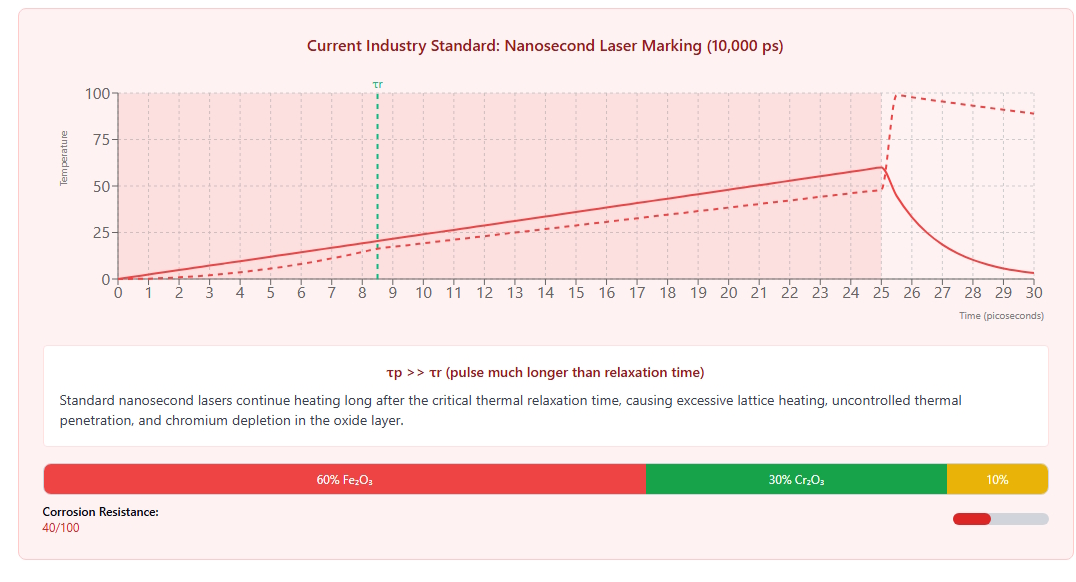
Stainless steel’s corrosion resistance depends on a stable chromium oxide (Cr₂O₃) passive layer. Nanosecond lasers create a chromium-depleted zone around the mark, compromising this protection.
The Science Behind the Failure:
- Thermal relaxation time (τr) is ~8.5 ps for stainless steel
- Nanosecond pulses (10,000 ps) exceed this by 1,000x
- Excessive heat creates iron-rich oxides instead of chromium-rich
- Heat-affected zone extends 15-50μm beyond visible mark
Failure Mechanism Progression
- 1
Nanosecond Laser Marking
10,000 ps pulse duration - 2
Thermal Penetration
Deep, uncontrolled heat-affected zone, 15-50μm beyond visible mark - 3
Chromium Depletion
Cr₂O₃ layer compromised - 4
Autoclave Sterilization
High temperature + moisture - 5
Corrosion Initiation
UDI mark degradation and failure
The Science of Thermal Relaxation in Stainless Steel
The UDI Compliance Problem
Medical devices marked with standard industry nanosecond lasers frequently experience UDI degradation and corrosion following autoclave cycles.
Common Industry Problems:
- Unexpected corrosion after autoclave cycles
- Loss of mark contrast following sterilization procedures
- UDI mark degradation leading to regulatory non-compliance
- Premature device failure due to corrosion initiation
The Root Cause: Chromium Depletion
Stainless steel’s corrosion resistance depends on a stable chromium oxide (Cr₂O₃) passive layer. Nanosecond lasers create a chromium-depleted zone around the mark, compromising this protection.
The Science Behind the Failure:
- Thermal relaxation time (τr) is ~8.5 ps for stainless steel
- Nanosecond pulses (10,000 ps) exceed this by 1,000x
- Excessive heat creates iron-rich oxides instead of chromium-rich
- Heat-affected zone extends 15-50μm beyond visible mark
Thermal Energy Transfer in Stainless Steel Laser Marking
- 1Thermal relaxation time (τr) is approximately 8.5 picoseconds for stainless steel
- 2Pulse duration determines energy transfer and oxide layer formation
- 3Precise pulse control is crucial for corrosion resistance and marking quality
Thermal Relaxation Time (τr) Significance
For stainless steel, the thermal relaxation time of 8.5 picoseconds represents a critical threshold where energy begins to transfer from electrons to the crystal lattice. This brief window determines the fundamental characteristics of laser-induced surface modifications.
Detailed Energy Transfer Mechanism
Initial Electron Excitation:
Laser energy absorbed by surface electrons. Duration 0-8.5 ps.
Color Representation: 
Depth Penetration: Confined to surface layer
Temperature Dynamics: Rapid, localized electron heating
Electron-Lattice Coupling:
Energy transfer from electrons to crystal lattice begins. Duration: 8.5-10 ps
Color Representation: 
Depth Penetration: Controlled energy propagation
Temperature Dynamics: Balanced electron-lattice interaction
Heat spread and oxide layer formations. Duration: 10-10,000 psColor Representation:

Depth Penetration: Extensive lateral and vertical spread
Temperature Dynamics: Uncontrolled thermal expansion
Laser Technology Comparison
| Parameter | Nanosecond (ns) | Picosecond (ps) | Femtosecond (fs) |
|---|---|---|---|
| Pulse Duration | 10⁻⁹ seconds (10,000 ps) | 10⁻¹² seconds (10 ps) | 10⁻¹⁵ seconds (0.5 ps) |
| Heat-Affected Zone | 15-50μm | 2-5μm | <1μm |
| Relation to Thermal Relaxation | 1000× longer | Slightly longer | Shorter than τr |
| Oxide Composition | Primarily Fe₂O₃ (iron) | Mixed Cr₂O₃/Fe₂O₃ | Primarily Cr₂O₃ (chromium) |
| Corrosion Resistance | Poor (40/100) | Good (75/100) | Excellent (90/100) |